The Fed doesn't set mortgage rates. Here's what does.
By Brandon · October 29, 2026
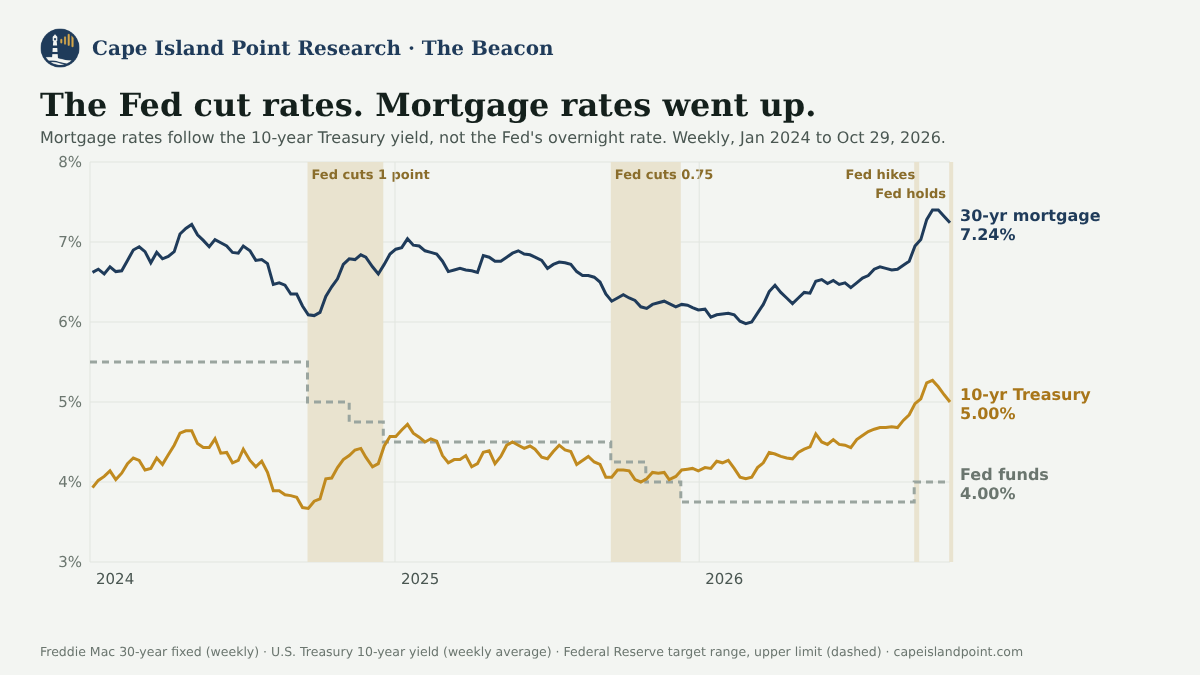
"Rates will come down when the Fed cuts" is one of the most repeated lines in real estate, and one of the least reliable. Over the past two years the Fed cut rates and mortgage rates went up. Here is what actually moves the rate on a 30-year loan, and what to watch instead.
- The Fed sets an overnight rate between banks. A 30-year mortgage is priced off the 10-year Treasury yield plus a spread, and the two move together far more closely than mortgages move with the Fed.
- When the Fed cut a full point from September to December 2024, the 30-year rate rose from about 6.2% to over 7%, because the 10-year yield rose a point at the same time.
- In 2026 the Fed held still from January to August, and mortgage rates rose from under 6% to about 6.8% anyway. They hit 7.40% after the September hike, then eased to 7.24% by late October as the 10-year yield fell, while the Fed held still again.
- Rates tied to the Fed do follow it: home equity lines, credit cards and adjustable-rate loans once their fixed period ends. A 30-year fixed does not.
"Once the Fed cuts, mortgage rates will come down." I've heard it from more than one agent this year, and it sounds right: the Federal Reserve sets interest rates, mortgages are interest rates, so a Fed cut should mean a cheaper mortgage. The last two years say otherwise.
What the Fed actually sets
The Fed sets one rate directly: the federal funds rate, what banks charge each other to borrow overnight. That rate drives other short-term borrowing. The prime rate moves with it almost to the day, and so do home equity lines of credit, credit cards and many adjustable-rate loans once their fixed period ends.
A 30-year fixed mortgage is a different animal. A lender is locking in a rate for decades, so it prices the loan off long-term money, not overnight money. The benchmark is the 10-year Treasury yield, the rate investors demand to lend to the U.S. government for ten years. Mortgage rates sit on top of it with a spread, usually about 1.7 percentage points.
In Freddie Mac's weekly survey since 1990, the four-week change in the 30-year rate and the four-week change in the 10-year yield have a correlation of about 0.87. When the 10-year moves, mortgage rates follow within days.
Recent tests
Fall 2024: the Fed cut, mortgages rose. The Fed cut its rate by a full point between September 18 and December 18, 2024. The week before the first cut, the 30-year rate was about 6.20%. By mid-January it was 7.04%. The 10-year Treasury yield rose from about 3.7% to 4.7% over the same months. Investors had expected the cuts for months and had already pushed long rates down before they came, so when the cuts arrived, long rates rose on worries about inflation and federal borrowing.
Fall 2025: three more cuts, a small dip. The Fed cut another three-quarters of a point between September and December 2025. The 30-year rate drifted from about 6.35% to about 6.16% by early January, a fifth of a point. The 10-year yield barely moved, and mortgage rates moved with it, not with the Fed.
2026: the Fed sat still, mortgages climbed. From January through August 2026 the Fed didn't change its rate at all. Mortgage rates rose anyway, from 5.98% in late February to about 6.76% in early September, as the 10-year yield climbed. The Fed then raised its rate a quarter point on September 16. By mid-October the 30-year was 7.40%, up nearly half a point, and the 10-year yield was 5.19%.
This month: the Fed held, mortgages eased. Over the next two weeks the 10-year yield fell back to about 5.00%, and the 30-year rate followed it down to 7.24% on October 29. The Fed did nothing to cause that. At its October 28 meeting it left its rate unchanged, and two members voted to raise it again.
So what does move the 10-year yield?
Mostly the things investors expect over the next decade, not this month's Fed decision:
- Inflation expectations. Lenders want to be paid back in money that still buys something. If they expect higher inflation, they demand a higher rate.
- Where the Fed is expected to be, not where it is. Markets price in cuts and hikes months ahead. By the time a cut happens, it is usually already in the price.
- Government borrowing. The more Treasury bonds the government has to sell, the higher the rate it may need to offer buyers.
- The economy. A slowing economy and falling job numbers tend to pull long rates down. That's why mortgage rates often fall fastest in a downturn, Fed or no Fed.
The spread on top of the 10-year matters too. It is about 2.2 points today, wider than its long-run average of about 1.7, which reflects how much investors want for holding mortgage bonds that can be paid off early. If that gap narrows, mortgage rates can ease even when the 10-year doesn't.
When the Fed does matter
The Fed isn't irrelevant to mortgages. Its decisions shape what investors expect about inflation and the economy, and a surprise (a cut nobody expected, or a sudden change of tone) can move the 10-year yield in a day. But the direction isn't guaranteed. A cut that markets read as a sign of a weakening economy can pull long rates down. A cut that markets read as the Fed going easy on inflation can push them up, which is roughly what happened in late 2024.
What this means if you're buying or refinancing
- Watch the 10-year Treasury yield, not the Fed's calendar. A drop of half a point in the 10-year usually shows up in mortgage quotes within a week or two.
- Be skeptical of timing a purchase around a Fed meeting. "Wait for the cut" has not reliably meant a lower rate.
- Know which of your loans follow the Fed. A home equity line or an adjustable-rate mortgage past its fixed period will reprice with the Fed. A 30-year fixed won't.
The weekly 30-year rate and the 10-year Treasury yield are both on the Mortgage rates tab of Market data, updated every Thursday.
— Brandon
Sources: Freddie Mac Primary Mortgage Market Survey® (weekly 30-year fixed); U.S. Treasury 10-year par yield; Federal Reserve target range (2024–2025 changes; September 16, 2026 increase; October 28, 2026 statement). Correlation: four-week changes, weekly data 1990 to October 2026. General information, not advice about any one person's decision.
See it in the data
- Mortgage rates and the 10-year yield, weekly
- Payment pressure and market conditions
- Where these numbers come from
The Beacon shows the math and the questions worth asking. It is general information, not advice about any one person's decision.