The November 3 sales tax vote: what it means for Johns and James Island
By Brandon · October 19, 2026
Charleston County voters decide whether to keep a half-cent sales tax for roads, transit and the Greenbelt. Here is what is on the ballot, what happened with the last one, which island projects depend on it, and what it could mean for housing.
- The vote is whether to keep a half-cent sales tax you already pay, for up to 25 years and about $4.25 billion. If it fails, the rate drops by half a cent when the current tax ends in 2027.
- The 2016 tax paid as it went instead of borrowing. Construction costs roughly doubled while projects waited. The 2026 plan borrows to build sooner and counts about $284 million in interest.
- Traffic on the bridges serving James and Johns islands grew 21% to 39% since 2018, while the Ravenel Bridge and Wappoo Cut barely changed.
- Some island fixes are funded either way. The Maybank and River Road roundabout, Maybank at Riverland, Main Road at Mary Ann Point and raising Seabrook Island Road depend on the vote.
On November 3, Charleston County voters decide whether to keep a half-cent sales tax that pays for most of the region's road work and for the land the county buys to keep it from being developed. It reads like a roads question. For anyone who owns, or wants to own, a home on Johns or James Island, it is also a housing question.
I watched the City of Charleston's recent "State of Our City" session on Johns Island so you don't have to sit through the hour, and pulled the traffic counts and the history of the last tax. Here is what the vote touches, in plain terms. This is not a recommendation on how to vote.
What's on the ballot
There are two questions on the ballot. The first is whether to extend a sales tax you are already paying, not whether to add a new one. The second lets the county borrow up to $300 million against that tax to start projects sooner.
- What it is: a half-cent (0.5%) sales tax for transportation. It would replace the county's 2004 half-cent tax when that one expires in 2027, so the rate you pay at the register would not go up. If the vote fails, the rate drops by half a cent when the 2004 tax ends.
- How long: up to 25 years.
- How much: about $4.25 billion over that time.
- Where it goes: about $2.7 billion (64%) to roads, including bike and pedestrian work; $860 million (20%) to public transit; and $690 million (16%) to the Greenbelt program that protects land.
- Who pays: the mayor said about half of this tax is paid by people who don't live in Charleston County: tourists, and commuters from Berkeley and Dorchester counties.
What the tax would pay for, line by line
The ballot itself names the projects in each category. It does not attach a dollar amount to each one, and it says that if a listed project can't be completed, its money goes to other projects on the list. The amounts below are from the county's May draft, as reported by the Post and Courier; council made small changes before final approval, so treat them as estimates.
Featured road projects
- US 17 South widening, Dobbin Road to SC 162 (Rantowles): about $445 million
- Johnnie Dodds Blvd. at Houston Northcutt Blvd., Mount Pleasant: about $230 million
- Battery Extension West / Calhoun Street–Medical District (seawall up the Ashley to Calhoun Street): about $225 million
- Rivers Avenue railroad overpass at Durant Avenue, North Charleston: about $175 million
- Long Point Road resiliency and safety improvements, Mount Pleasant: about $170 million
- Glenn McConnell Parkway at Magwood Road, West Ashley: about $100 million
- Mall Drive improvements, North Charleston: about $100 million
- Maybank Highway southern pitchfork and roundabouts, Johns Island: about $65 million
- Patriot Boulevard widening; Hagood Avenue improvements; Wingo Way improvements; Better North Bridge pedestrian and bicycle improvements (amounts not itemized in the reporting)
Intersection projects (about $115 million in the draft): Stall Road at Midland Park and Ashley Phosphate; Ladson Road at Palmetto Commerce Parkway; Ashley Phosphate at Cross County and Brandywine; US 78 at Limehouse Lane; Savannah Highway at Ashley Town Center Drive; Maybank Highway at Riverland Drive; Main Road at Mary Ann Point roundabout; SC 162 at Salters Hill roundabout; SC 174 at SC 164 roundabout; Steed Creek Road at US 17 North; SC 45 at US 17 North; Whipple Road at Mathis Ferry Road; Lucy Beckham High School.
Everything else in the roads category
- Pavement management (about $390 million): countywide resurfacing, a rural road safety program, and a road elevation program for flooding, including Seabrook Island Road
- Bike and pedestrian (about $75 million): countywide plan, Rivers Avenue rapid transit connections, the City of Charleston Safe Streets plan, the Rethink Folly Road plan and the Mount Pleasant Way
- Unfinished 2016 projects (about $113 million): Dorchester Road widening and Palmetto Commerce Parkway Phase 3
- Traffic signal synchronization (about $25 million), Reynolds Avenue improvements, a noise wall at the Palmetto Commerce interchange, and future transportation and drainage needs
Transit, $858 million: CARTA operations and expansion, new buses, and a downtown route study.
Greenbelt, $690 million: split evenly between urban and rural areas, for land purchases, conservation easements, parks, greenspace and waterway access.
Borrowing: the second ballot question allows up to $300 million in bonds, repaid from the tax, to start projects sooner. The plan counts about $284 million in interest.
Projects on or near Johns and James islands are in bold.
The bridges, by the numbers
SCDOT's traffic counts show where the pressure is. Since 2018, the James Island Connector added about 17,100 vehicles a day (+34%) and the Stono Bridge on Maybank about 11,200 (+39%). The Limehouse Bridge on Main Road, Johns Island's other way off, is up 21%. Over the same years the Ravenel Bridge (+3%) and the Wappoo Cut bridge on Folly Road (+4%) barely changed.
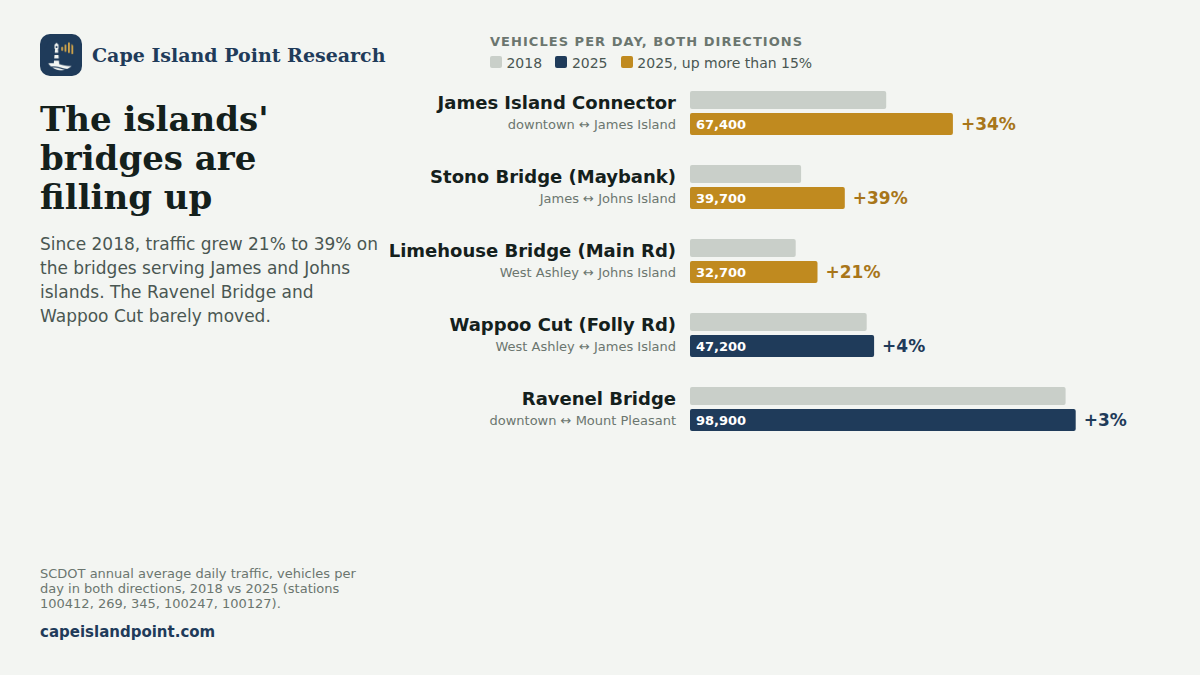
Johns, Kiawah, Seabrook and Wadmalaw have roughly 32,000 to 35,000 year-round residents, and every trip on or off those islands uses one of two bridges, which together carried about 72,000 vehicles a day in 2025.
Pay as you go, or borrow?
The 2016 sales tax took what looked like the safe route: no borrowing. The county paid for projects as the tax money came in, which avoided interest and debt. (The 2004 tax had borrowed against future collections.)
The catch was time. Big road projects already wait years for design and permits, and pay-as-you-go adds another wait, for the money to pile up. While the 2016 projects waited, construction got much more expensive. Federal highway cost data show costs up about 59% since mid-2021, and the county has said its project costs roughly doubled since 2016. As of fall 2024, one of the 17 projects from the 2016 tax was finished.
Borrowing would have cost interest, but money was cheap then. In early 2021, a widely used index of 20-year municipal bond rates stood around 2.4%. When construction costs rise faster than the interest rate, every year of waiting costs more than the interest it saves. So the cautious choice still carried a risk, just a different one: that building would get more expensive while the county saved up.
To be fair to the county, almost no one saw the 2021 to 2023 jump in construction costs coming, borrowing would not have skipped design and permits, and debt carries its own risk if sales tax comes in short. The 2026 plan borrows against future collections to start projects sooner, and it counts about $284 million in interest as part of the cost. Whether that is the better trade is part of what voters are weighing.
Your property tax bill
This vote doesn't change your tax bill directly, but it affects how future road work gets paid for.
At the meeting, the city used an average Johns Island home price of $690,000 and showed that Charleston homeowners pay less than homeowners in places like Greenville and Lexington counties. A big reason is sales tax: a separate local sales tax, which is not on this ballot, pays for a credit that lowers property tax bills, and that credit is worth more for owner-occupied homes. That credit stays either way.
The mayor's argument is that if the transportation tax ends, the money for roads and intersections has to come from somewhere, and the main alternative is a higher property tax rate, which only residents pay. Supporters see that as the real tradeoff. Opponents point to the delays and cost overruns on past projects and want more accountability first. The mayor said a recent audit of the previous two sales taxes came back clean.
Your commute
Some Johns Island fixes are already paid for and happen no matter how the vote goes. The biggest fix for the Maybank and River Road intersection depends on it.
| Project | Depends on the vote? | Timing |
|---|---|---|
| Fourth lane on Maybank (River Rd to Stono bridge) | No, already funded | Construction starts early 2027 |
| Main Road flyover at Highway 17 | No, under construction | Pieces open this year, done in 2028 |
| Smart signals on Maybank that adjust to traffic | No | Coming soon |
| "Southern pitchfork" and roundabout at Maybank and River (about $65M) | Yes | After the vote |
| Maybank and Riverland intersection on James Island | Yes | After the vote |
| Second turn lane off the Wappoo Cut bridge onto Maybank | Yes, per the mayor | After the vote |
| Main Road at Mary Ann Point roundabout | Yes | After the vote |
| Raising Seabrook Island Road against flooding | Yes | After the vote |
| Rethink Folly Road bike and pedestrian plan (James Island) | Yes | After the vote |
The city is also adding things that keep people on the island: a $65 million recreation center with a pool near Hayes Park, a new fire station, and a 24/7 emergency room on Maybank expected by the end of 2026.
What it means for housing
The vote matters most for what doesn't get built.
- Most of the building is already approved. The mayor said about 90% of the land approved for development inside city limits on Johns Island is built out. Many of those approvals date back 20 to 25 years and assumed I-526 would come. It won't.
- The city can't simply say no. South Carolina protects property rights strongly. If the city cuts how many homes an owner can build, it can owe the owner for the lost value. So the city is using other tools: strict stormwater rules (one 91-unit apartment plan has been turned down three times), a proposed rule that would hold building permits until a failing nearby intersection is fixed, and a firm line on the urban growth boundary.
- Greenbelt money buys land, or the right to build on it. About $690 million of this tax would go to the Greenbelt program. That money can buy land outright, or pay owners to give up the right to build on it, which the mayor said is often cheaper than building the roads to serve it.
Put together: little new supply on the way, some road fixes arriving through 2028 either way, and a vote that decides how much more gets built and how much rural land the county can afford to protect.
Before you vote
I'm not telling anyone how to vote. That's your call, and reasonable people land on both sides. What I'd suggest is reading the actual project list and deciding with the numbers in front of you. As always, I'm happy to talk through the numbers with anyone.
James Island residents: your State of Our City meeting is Thursday, November 5, at 6:30 p.m. at James Island Elementary. That's two days after the vote, so it's a good chance to ask what the result means for your side of the Maybank corridor.
— Brandon
Sources: the ballot questions and CharlestonTransportation.com, Charleston County; State of Our City – Johns Island, City of Charleston; Charleston County voters to decide $4.25 billion transportation sales tax Nov. 3 and the project list, Post and Courier; Live 5 News; Has Charleston County completed road tax projects from 2016?, Post and Courier; Eno Center for Transportation (FHWA National Highway Construction Cost Index); Bond Buyer 20-Year GO Rate, March 2021; Post and Courier ($284.1 million in interest); the LOST property tax credit, Post and Courier; SCDOT annual average daily traffic counts (via the BCD Council of Governments and SCDOT station files). Not a recommendation on how to vote.
See it in the data
- Johns Island and James Island numbers by town
- Market conditions and payment pressure
- Where these numbers come from
The Beacon shows the math and the questions worth asking. It is general information, not advice about any one person's decision.