October 2026: rates easing, conditions warmer, prices still flat
By Brandon · November 17, 2026
The short version: the market warmed a little in October as mortgage rates came off their highs. Prices are holding in dollars, but with inflation running near 4%, the typical Charleston-area home is still worth less than a year ago in real terms.
Market conditions: about normal, and warmer
The Charleston area's Tide Gauge™ reads 48, about normal for the time of year. That's up from 43 in September and 29 a year ago. Fifty is normal for each town at that time of year; above 50 favors sellers and below 50 favors buyers.
All three counties warmed. Berkeley County moved the most, from 45 to 54. Charleston County went from 45 to 47, and Dorchester County, which here means Summerville, from 31 to 40. Dorchester is still the coolest of the three.
The biggest moves among towns: Goose Creek rose from 40 to 52, Moncks Corner from 59 to 69, Folly Beach from 64 to 71, Hollywood from 35 to 45 and the City of Charleston from 44 to 50. Johns Island went from 44 to 53. Going the other way, Sullivan's Island fell from 37 to 29, Seabrook Island from 68 to 62 and Mount Pleasant from 51 to 46.
What has followed a reading like this? Across 14 towns since 2016, a score between 40 and 60 was followed by values about 4% higher a year later, and lower only about one time in seven. The score shows which way a market is leaning, not a forecast. (How the score has done.)
Rates are easing, but payments are still higher than in spring
Freddie Mac's 30-year average fell four weeks in a row, from 7.40% in mid-October to 7.11% on November 12. The Fed didn't cause it; it held steady on October 28. Mortgage rates followed the 10-year Treasury yield down. (Why the Fed isn't the number to watch.)
On the typical Charleston-area home with 20% down, principal and interest now comes to about $2,323 a month. That's still about 8% more than in early May, when the rate was 6.37%.
Last month I wrote that a jump in the payment like this has usually come before cooler conditions. October went the other way. That pattern plays out over about six months, so one warmer month doesn't settle it, but it's worth saying plainly.
Prices: flat in dollars, down after inflation
From the local MLS, single-family homes in October:
- Charleston County: median $726,500, down 5.6% from a year ago. The average rose 4.5%, so most of that drop is which homes sold. Homes took 44 days to go under contract, down from 50, and new listings fell 13%.
- Berkeley County: median $438,607, up 4.4%. New listings fell 22%.
- Dorchester County: median $395,000, unchanged. Sales fell 25% and homes for sale rose 25%, the softest numbers of the three.
Zillow puts the typical Charleston-area home at about $431,600, flat in dollars (−0.2% in a year). Zillow also revised its earlier figures this month: September is now about $431,500, not the $437,000 in last month's note. The direction didn't change, just the level.
Prices for everything else rose about 4.0% over the year. After inflation, the typical home here is worth about 4.1% less than a year ago and 7.6% below its peak of June 2024. One caution on that inflation figure: the government never collected October 2025 prices because of last year's shutdown, so the year-over-year comparison uses an estimate for that month.
After inflation, by town
Last month we compared Charleston with other Southern cities. This month, our own towns. Only three are worth more than ever after inflation, all of them high-end beach towns where more buyers pay cash. Everywhere else is below its peak:
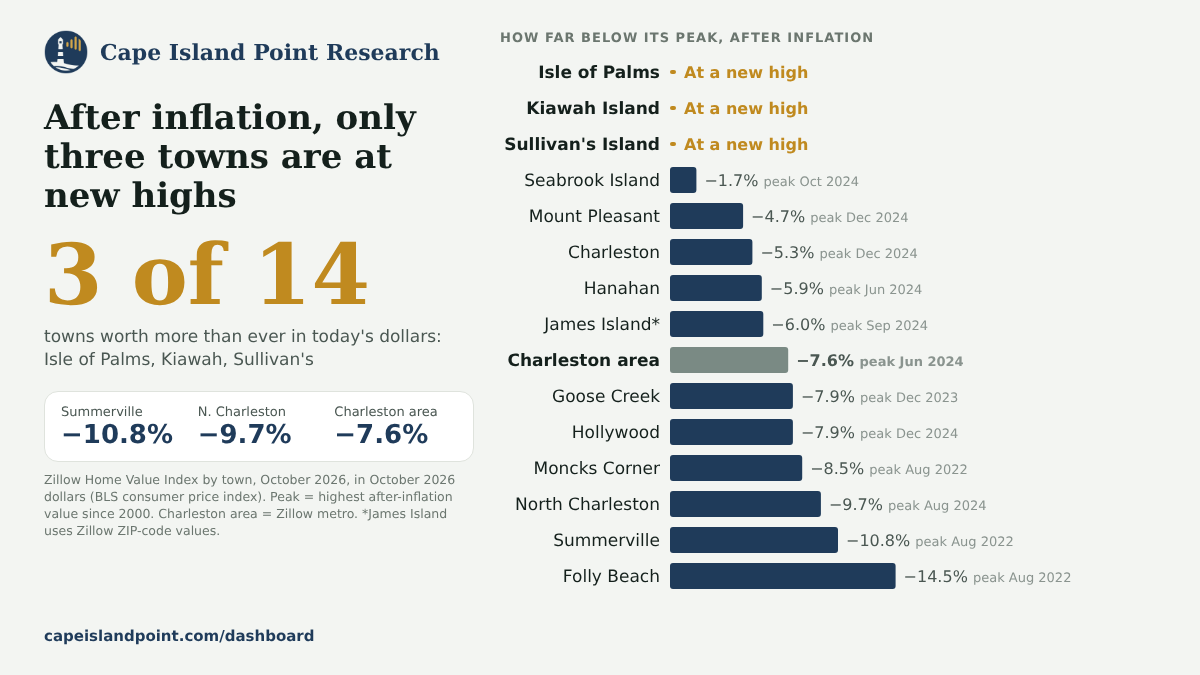
Folly Beach is the interesting one. It's one of the hottest markets on the Tide Gauge right now (71), yet it is 14.5% below its 2022 peak after inflation. Homes there are selling quickly, just at prices that haven't kept up with everything else since 2022.
To see any town's home values after inflation, use the "After inflation" switch on the home value charts in Market data.
From The Beacon
New on the site since the last note:
- James Island: what the city said about roads, growth and the land that won't be built on. The mayor says the island is mostly built out; Riverland Oaks shrinks from 146 homes to about 91.
- The Fed doesn't set mortgage rates. Here's what does. The Fed cut a full point in 2024 and mortgage rates went up.
- The builder's rate buydown: what you're really buying. A low rate beats a price cut on the payment, but not if you sell or refinance in a few years.
- Daniel Island and Cainhoy: what the city said about growth and traffic. Clements Ferry traffic is up 54% since 2015, and Point Hope could still add thousands of homes.
- The sales tax vote and Johns and James Island. Voters renewed it with about 64% yes.
What I'm watching
- Whether the warmer reading holds with payments still about 8% above spring.
- Rates near 7%. A move toward 6.5% would likely bring more buyers back quickly; a bounce back toward 7.5% would test October's warmth.
- Dorchester County supply. Homes for sale are up 25% in a year there. If that keeps building, expect more price cuts in Summerville.
Look up your town
Charleston · Mount Pleasant · North Charleston · Summerville · Goose Creek · Hanahan · Moncks Corner · James Island · Folly Beach · Isle of Palms · Sullivan's Island · Kiawah Island · Seabrook Island · Hollywood · All 27 towns
Have a question about the data, or a topic you'd like me to dig into? Email me. I can't advise on individual decisions, but I'm always happy to talk numbers.
— Brandon
Sources: Charleston Trident Association of REALTORS® (CTAR) Local Market Updates via ShowingTime (October 2026, single-family); Zillow Home Value Index (October 2026); Redfin Data Center (Tide Gauge inputs, three months ending October 2026); Freddie Mac Primary Mortgage Market Survey®; Bureau of Labor Statistics CPI-U (October 2025 estimated as the average of September and November 2025). Monthly payment is principal and interest only, 20% down. See every number in Market data.